English
 中文
中文 Русский
Article Overview: This article helps engineering and procurement teams select a waterproof junction box for solar panels, answering which IP rating and enclosure materials outdoor PV DC connections require. The evidence-bounded conclusion: IP66 is the practical benchmark, delivered through UV-resistant polycarbonate housings, compression-sealed lids, and rated cable glands. Findings are based on published enclosure guidance and IP rating principles, not third-party test data.
What IP rating does a waterproof junction box for solar panels need?
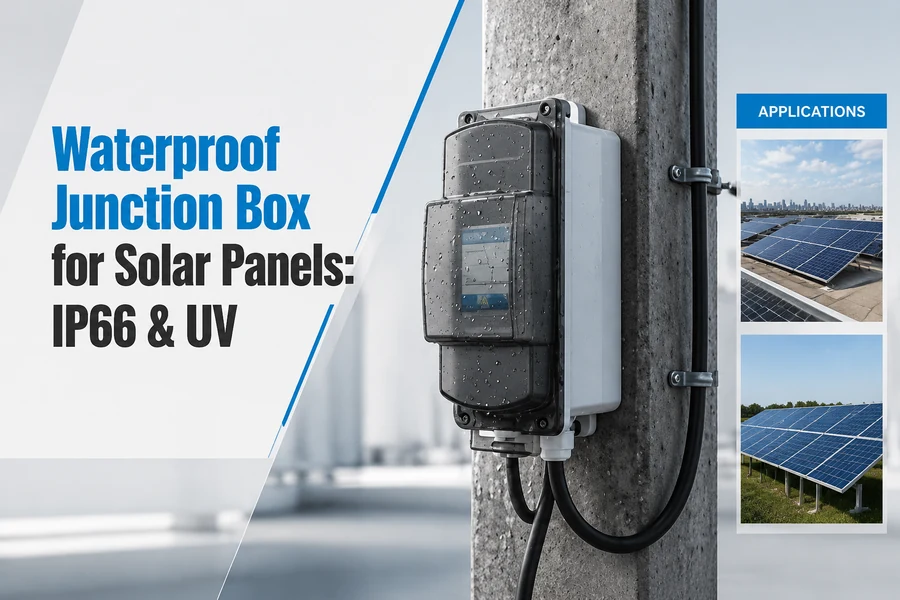
For outdoor solar DC connections—string-level junction boxes and DC combiner boxes alike—IP66 is the practical benchmark: fully dust-tight and resistant to powerful water jets. Higher ratings add submersion protection rarely required in PV installations.
The Ingress Protection code exists because “waterproof” has no absolute meaning in industrial specifications. The first digit rates protection against solid particles; the second digit rates protection against water. IP66 therefore describes a fully dust-tight enclosure that withstands powerful water jets, making it suitable for exposed locations where rain, wind-driven moisture, or hose-down cleaning are routine. For photovoltaic systems, this baseline applies both to string-level junction boxes that consolidate module conductors and to DC combiner boxes that aggregate multiple strings before the inverter.
A lower second-digit rating that only protects against splashing water is not designed for continuous outdoor exposure. On a PV array, wind can drive rain horizontally at the enclosure wall, and maintenance staff may use hose-down cleaning; both situations exceed what a splash-water test simulates. This is why the IP66 benchmark has become the baseline reference for outdoor low-voltage applications.
- First digit (0–6)
- Protection against solid particles; level 6 means dust-tight with no dust ingress during the test.
- Second digit (0–8)
- Protection against water; level 6 means protection against powerful water jets, covering rain and wash-down exposure.
Enclosure suppliers are not required to rate the empty shell and the fitted glands identically. Procurement teams should therefore treat the rating as a specification floor, then verify that the full assembly—box, lid, gasket, and cable glands—holds the rating under the manufacturer’s test documentation. The same reasoning appears in the waterproof outdoor electrical junction box guide, which examines how enclosure materials and sealing details protect low-voltage connections in renewable energy applications.
Why is UV-resistant polycarbonate important for solar enclosures?
UV-resistant polycarbonate prevents enclosure embrittlement and discoloration under continuous sun exposure. A solar junction box mounted outdoors faces years of direct radiation, and UV-stabilized PC can maintain sealing integrity longer than unstabilized thermoplastics.
A PV enclosure is rarely shaded. It is mounted on or beside the array and receives direct solar radiation for much of the day, season after season. Ultraviolet light degrades many polymers by breaking molecular bonds, which appears as surface chalking, color shift, and eventually embrittlement. A brittle enclosure is a direct threat to the IP seal: lid clips can snap, gasket channels distort, and cable gland threads lose their grip, opening paths for moisture.
Thermal cycling compounds the problem. An enclosure surface in full sun can heat well above ambient temperature during the day and cool at night, causing the lid and body to expand and contract at different rates. UV degradation reduces the flexibility that lets a gasket absorb those movements. A UV-stabilized polycarbonate body keeps its dimensional tolerances so the compression seal remains consistent over the array’s operating life.
Published guidance for outdoor electrical enclosures notes that material choice directly influences long-term waterproof performance, with thermoplastics like polycarbonate commonly used for outdoor bodies. UV-stabilized grades add absorbers that slow photo-degradation. For a solar junction box, dimensional stability matters as much as strength because the gasket depends on consistent compression around the lid perimeter.
How do junction boxes protect low-voltage DC connections in PV systems?
Junction boxes protect low-voltage DC connections by combining a dust-tight, water-resistant enclosure with a compression-sealed lid and waterproof cable glands. Each cable entry must preserve the same IP rating as the box itself, because one undersized gland breaks the whole sealing system.
A solar junction box is a passive component with a specific job: keep terminated conductors isolated from water, dust, and mechanical damage. The protection is not a single gasket; it is a system of interlocking design features. The enclosure body and lid form a compression seal, often with a continuous polyurethane or silicone gasket. Cable entry points require compatible waterproof cable glands that maintain the enclosure’s overall IP integrity.
Every conductor leaving the box is a potential water path. A correctly sized cable gland compresses evenly around the cable jacket while its sealing ring seats against the enclosure wall. Gland selection is a two-sided decision: the gland thread must match the enclosure wall thickness, and the gland body must match the outer diameter of the cable. An undersized gland crushes the cable; an oversized gland leaves a gap that violates the IP rating.
Phase 1: Seal the perimeter
The lid compresses a continuous polyurethane or silicone gasket against the enclosure body to create the dust and water barrier.
Phase 2: Protect every cable entry
Each cable gland is matched to the cable diameter and tightened so its sealing ring holds the same IP rating as the box.
Phase 3: Validate the complete assembly
Confirm that the box, lid, hinges, and gland plates are rated together; a single omitted or undersized gland can fail the entire enclosure.
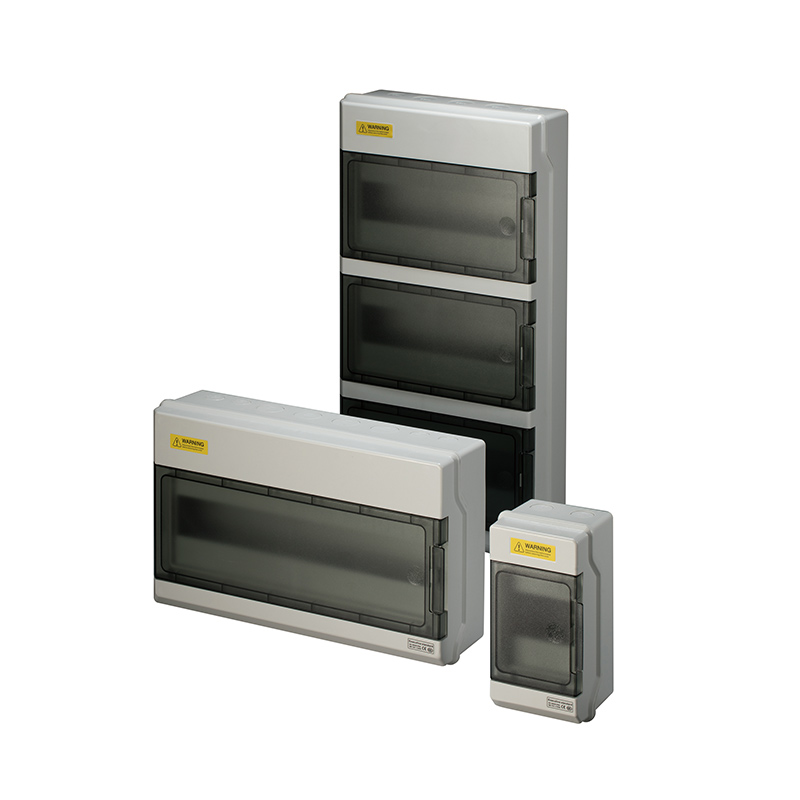
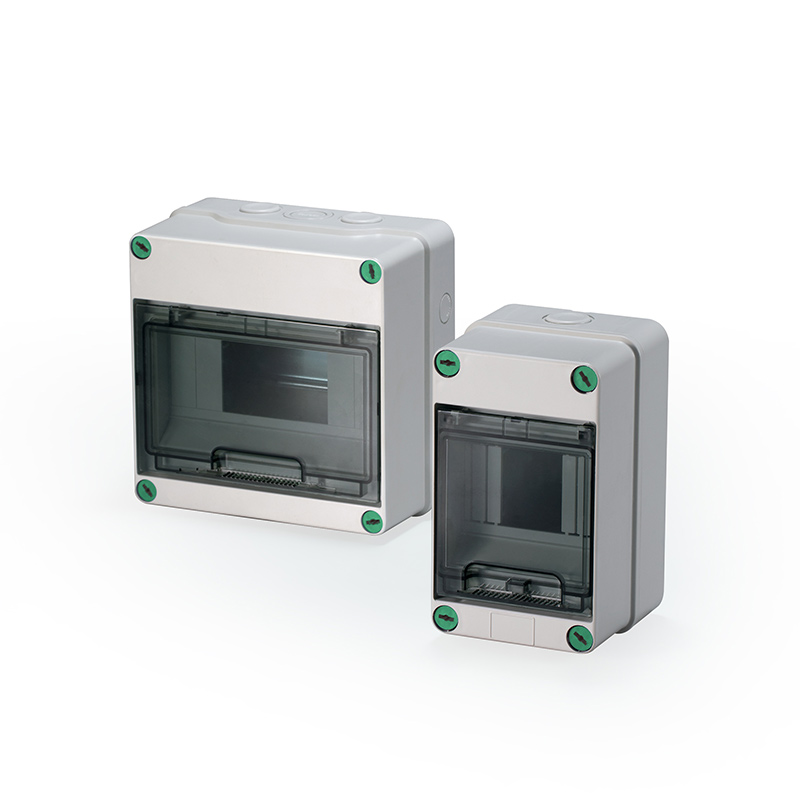
This is why procurement teams evaluate the complete assembly—box, lid, hinges, and gland plates—as a single protective system rather than isolated components. In PV systems, connections may remain sealed for years between inspections, so the sealing system must survive thermal cycling, wind-driven rain, and UV exposure without maintenance. The published specification for an IP66-rated waterproof outdoor electrical junction box shows how these sealing features are implemented at product level.
What enclosure features matter for rooftop versus ground-mount solar?
Rooftop and ground-mount solar installations both need IP66 enclosures, but they stress different features: rooftop arrays face wind-driven rain and limited access, favoring compact boxes with secure glands; ground-mount sites face dust, hose-down cleaning, and frequent inspection, favoring hinged, tool-accessible designs.
The IP66 baseline does not change between scenarios; the priority of secondary features does. Rooftop arrays are exposed to wind-driven rain and usually sit in constrained spaces near the module frame. Ground-mount systems are closer to soil and vegetation, so dust and abrasive particles become the dominant contaminant, and service teams tend to open enclosures more often for inspection or string reconfiguration.
| Scenario | Typical exposure | Priority enclosure features |
|---|---|---|
| Rooftop array | Wind-driven rain, direct UV, constrained service access | Compact footprint, stable compression seal, correctly sized cable glands |
| Ground-mount site | Dust, hose-down cleaning, frequent inspection and expansion | Dust-tight IP66 seal, hinged lid for repeated panel access, gland plates for clean re-entry |
For rooftop arrays, the priority is preventing wind-driven moisture from entering through under-specified glands while keeping the enclosure small enough to mount near the modules. Work at height makes every maintenance visit more expensive, so the enclosure should require only simple tool access, and cable entries should be positioned to avoid sharp bends that stress the glands. For ground-mount sites, dust-tightness and serviceability lead; an IP66 first-digit rating of 6 keeps abrasive particles away from terminals. Because ground-mount systems are opened more often, a hinged junction box design for panel access reduces the chance of gasket damage during repeated maintenance.
Neither scenario changes the baseline IP requirement; both should start with IP66. What changes is how much weight to place on access, cable management, and dust behavior when comparing products.
How should procurement teams verify IP66 performance before purchase?
Verify the IP66 claim against manufacturer documentation for the complete assembly—body, lid, gasket, hinges, and fitted cable glands—not the empty enclosure. Request evidence of UV-stabilized polycarbonate, an approved gland list, and assembly-level test documentation before purchase.
An IP code on a datasheet is a starting point, not proof. The rating is meaningful only when the configuration you intend to install has been tested. That means the enclosure model, gasket material, gland thread, and cable diameter range must align with the supplier's declared assembly. If the supplier cannot provide assembly-level documentation, treat the IP66 claim as unverified for your application.
In practice, the verification workflow is simple: confirm the enclosure body is rated, confirm the gland plate or pre-configured glands match your cable entries, and confirm the polycarbonate grade includes UV stabilization. These three checks are independent. For example, a box with a perfect seal but non-UV-stabilized material will fail differently from a box with UV-stabilized material and an undersized gland.
FAQ
Is a higher water rating needed for solar junction boxes?
Not for most rooftop or rack-mounted arrays. IP66 already covers wind-driven rain, powerful water jets, and hose-down cleaning, which are the routine exposures for PV enclosures. A submersion-rated enclosure is worth specifying only where there is a real flood risk or standing-water scenario, because heavier sealing can make future access and cable re-entry more difficult.
Can an ordinary outdoor junction box be used for solar DC connections?
Yes, provided it meets the same environmental requirements: IP66 sealing, a UV-stabilized enclosure material such as polycarbonate, and cable glands rated for the installed cable diameter. The enclosure does not need to be labeled as solar-specific if its assembly-level rating and material specification match the exposure. Verify the assembly rating rather than relying on the enclosure body alone.
Does the IP66 rating still apply if we fit our own cable glands?
Only if the glands are compatible with the enclosure and installed correctly. The rating applies to the complete assembly, and a mismatched gland can admit water or dust even when the box lid is sealed. Use the manufacturer’s approved gland list, or order the enclosure with pre-configured gland plates, to preserve the IP66 performance in the configuration you actually install.
Conclusion
Selecting a waterproof junction box for solar panels comes down to four decisions: set IP66 as the minimum rating, require UV-stabilized polycarbonate for sun-exposed housings, verify that gaskets and cable glands preserve the rating on the full assembly, and weight access features toward the installation scenario. Rooftop and ground-mount sites both start from the same IP66 baseline, but dust exposure and service frequency determine whether a hinged, tool-accessible design is justified. These conclusions follow from published enclosure guidance and the IP rating system; final product ratings should be confirmed against the manufacturer’s own test documentation before purchase.