English
 中文
中文 Русский
Article Overview: This article explains the IP66 waterproof junction box rating system used in outdoor low-voltage installations. Engineering managers and technical buyers will learn what the test conditions cover, how enclosures achieve protection, and why IP66 is the outdoor benchmark. The discussion is limited to IP66 versus general IP54 contexts and does not cover IP67/IP68 comparison.
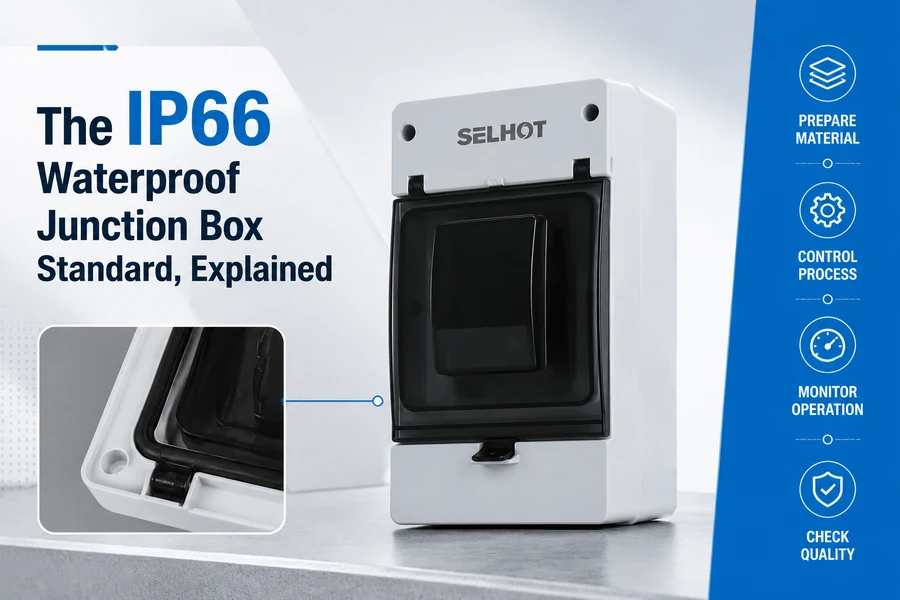
What Does an IP66 Waterproof Junction Box Rating Mean?
An IP66 rating means a junction box is dust-tight and protected against powerful water jets from any direction, suitable for exposed outdoor low-voltage installations. The rating defines test conditions; it does not promise permanent waterproofing.
In industrial specifications, the word "waterproof" is not absolute. It is defined by the Ingress Protection (IP) code, which classifies how well an enclosure keeps out solid objects, dust, and water. For most outdoor low-voltage applications, an IP66 rating has become the benchmark when a waterproof outdoor electrical junction box is required.
The IP code uses two digits. The first digit describes protection against solids and dust; the second digit describes protection against water. For IP66, the first digit (6) means dust-tight: no dust enters the enclosure during the test. The second digit (6) means the enclosure is protected against powerful water jets directed at it.
Because of these two properties, an IP66-rated box is considered suitable for exposed locations where rain, hose-down cleaning, or wind-driven moisture are routine. It is not a guarantee that the box will stay dry forever under every condition, but it establishes a clear, testable baseline for outdoor protection.
Across sectors such as renewable energy and telecommunications, performance requirements are shifting toward enclosures that can remain sealed for years with minimal intervention. A dust-tight, powerful-jet-resistant rating gives operators a shared specification language when comparing products from different suppliers.
How Is IP66 Protection Achieved in an Outdoor Electrical Enclosure?
IP66 protection comes from a system: compression-sealed body and lid, a continuous polyurethane or silicone gasket, compatible waterproof cable glands, and correctly installed gland plates. Every entry path must preserve the seal.
The protection does not come from a single gasket alone. It is a system of interlocking design features. The enclosure body and lid must form a compression seal, often using a continuous polyurethane or silicone gasket. Cable entry points require compatible waterproof cable glands that maintain the enclosure's overall IP integrity. If a single gland is omitted or incorrectly sized, the entire enclosure can fail.
The sequence matters because each component depends on the previous one. A correctly installed gasket cannot compensate for a gland that does not match the cable. Likewise, a well-sealed gland cannot fix a lid that is warped or a hinge that prevents even compression.
Phase 1: Prepare the enclosure body and lid
The mating surfaces must be clean, flat, and free of debris so the gasket can seat evenly. Dust or contamination here creates a leak path.
Phase 2: Install the continuous gasket seal
A polyurethane or silicone gasket is placed around the lid or body. When the lid is closed and tightened, the gasket compresses to block water and dust.
Phase 3: Fit compatible cable glands and gland plates
Each cable entry needs a waterproof gland matched to the cable diameter. Unused openings are closed with gland plates or blanking plugs rated for the same protection level.
Phase 4: Assemble and verify the complete system
Once every component is in place, the assembled system—box, lid, hinges, and glands—delivers the stated IP rating. The rating applies to the complete assembly, not to any single part.
Material choice directly influences long-term waterproof performance. Thermoplastics such as polycarbonate are common because they hold their shape under temperature changes and resist impact. A rigid body supports the gasket evenly; a soft or warped body creates areas where the seal compresses unevenly.
Procurement teams often evaluate the complete assembly rather than isolated components. This is why manufacturers list the enclosure, lid, and gland plates as one protective system. For a broader decision checklist covering enclosure materials and application sectors, technical buyers can start with the waterproof outdoor electrical junction box guide.
Why Do Outdoor Low-Voltage Connections Need IP66 Instead of IP54?
IP66 is specified for outdoor low-voltage connections because rain, wind-driven moisture, and hose-down cleaning expose enclosures to more demanding water conditions than IP54 can withstand. IP54 blocks splashing water, while IP66 resists powerful jets and full dust ingress.
IP54 is a general-purpose rating. It can be a reasonable choice indoors or in sheltered locations, but outdoor connections face a different environment. A box mounted on an exterior wall, a telecom pole, or a renewable-energy installation must handle rain, condensation, spray from sprinklers, and cleaning routines that deliver water with more force than simple splashing.
When comparing ratings, note that the second digit alone does not describe the same water condition. IPx4 is a splashing-water test, while IPx6 exposes the enclosure to powerful water jets. For an outdoor installation, the difference is not theoretical: cleaning routines that direct powerful jets of water, heavy rain driven by wind, and condensation inside the enclosure can all create conditions that a splash-rated box was never designed to survive.
| Protection attribute | IP54 | IP66 |
|---|---|---|
| Dust protection | Dust-protected; some dust may enter | Dust-tight; no dust enters |
| Water protection | Protected against splashing water | Protected against powerful water jets |
| Outdoor exposure | Sheltered locations | Exposed locations, rain, hose-down cleaning |
The practical difference is the failure boundary. An IP54 box may pass in calm, sheltered conditions but start to leak when water is sprayed directly at seams, around a gland, or across the lid. IP66 removes that uncertainty for outdoor low-voltage installations.
This is why many outdoor specifications state IP66 as the minimum. It avoids the need to distinguish between "some dust" and "no dust" or between "splashing" and "jets" during procurement.
When specifications call for a dust-tight enclosure that survives routine hose-down cleaning, an IP66-rated outdoor electrical junction box is the usual starting point.
Does an IP66 Rating Mean the Junction Box Never Leaks?
No. An IP66 rating reflects a tested condition of an assembled product, not a permanent guarantee. Seal aging, damaged gaskets, or incorrectly fitted glands can allow water to enter over time. Waterproofing is system design, not a lifetime promise.
The rating is established under specific test conditions on a properly assembled enclosure. It does not describe what happens after years of sunlight, temperature cycling, or mechanical impact. It also cannot protect against installation errors.
In practice, the most common failure points are the ones the IP code cannot control:
- A cable gland that is not matched to the cable diameter.
- A lid left partially open or a gasket that is pinched during closure.
- A blanking plate missing from an unused entry.
- Damage to the enclosure body that creates a direct path for water.
During commissioning, a simple visual check can prevent avoidable failures: confirm the gasket sits flat, all glands are present and tightened, and no blanking plate is missing. These checks will not change the theoretical IP rating, but they determine whether the installed box actually meets that rating.
To understand how a specific product implements this system, review the IP66 outdoor electrical junction box specification.
FAQ
What does the first digit in an IP66 rating mean?
The first digit (6) means the enclosure is dust-tight under the test condition. No dust enters the box. This matters outdoors because windblown dust and dry debris can otherwise work into seams and around gaskets, gradually weakening the seal.
What happens if one cable gland is omitted on an IP66 junction box?
The assembly no longer guarantees IP66 protection because the rating applies to the complete enclosure with all designated cable entries sealed. A single missing or incorrectly sized gland creates an entry path for water and dust. This is why procurement teams check the full assembly rather than only the box body.
Can an IP66 junction box be washed down with a hose?
Yes. The IP66 test condition includes powerful water jets, so routine hose-down cleaning is within the intended use. The rating assumes the lid is closed, the gasket is intact, and all glands are correctly fitted. Any damage to those parts will reduce the protection level in practice.
Conclusion: Why IP66 Is the Standard for Outdoor Connections
IP66 is the outdoor benchmark because it combines dust-tight construction with protection against powerful water jets. Achieving that rating requires more than a gasket: the body, lid, continuous seal, cable glands, and gland plates must work as one system. IP54 may be enough in sheltered spots, but outdoor low-voltage connections routinely face rain, wind-driven moisture, and hose-down cleaning. An IP66 rating is a tested baseline, not a lifetime promise, so installation quality and complete assembly matter as much as the IP code itself.